
How to Choose Educational TV Shows for Preschoolers

Preschoolers can learn a lot from a screen, but only when the show is built for how young children actually think, listen, move, and remember. A bright cartoon with letters on the wall is not automatically educational. A calm, well-paced show with repetition, meaningful stories, and chances to respond often teaches more than one packed with songs, jokes, and flashing action.
The goal is not to find a “perfect” show. The goal is to choose programming that supports real learning, fits your family’s values, and leaves room for play, books, talk, rest, and hands-on discovery.
Good educational TV shows for preschoolers usually share a few traits. They have clear learning goals. They move at a child-friendly pace. They model kind behavior. They invite children to think, not just stare. Most of all, they give adults something to build on once the episode ends.

Start with the learning goal
A preschool show should make it clear what it is trying to teach. The lesson does not need to feel like school, but it should have a purpose beyond keeping children quiet.
Look for shows that focus on skills preschoolers are ready to practice, such as:
Recognizing letters, sounds, numbers, shapes, and patterns
Building vocabulary through stories and songs
Understanding feelings and social situations
Practicing problem-solving and flexible thinking
Learning everyday routines, like sharing, cleaning up, or trying again
Exploring nature, animals, music, art, and community helpers
The best shows usually stay focused on one or two ideas at a time. For example, an episode about measurement might compare tall and short blocks, sing a simple counting song, and show characters using the words “longer,” “shorter,” and “same.” That is more useful than an episode that races through colors, counting, space travel, friendship, rhyming, and a dance party all at once.
Young children need repetition. If a show repeats a word, question, or concept several times, that can be a strength. Adults may find it tedious, but repetition helps preschoolers remember and use new ideas.
A useful test is simple: after the episode, can the child do something with what they saw?
That might sound like:
“Can you find something shaped like a triangle?”
“What did the character do when they felt mad?”
“Should we count your crackers like they counted the apples?”
“Can you sing the clean-up song while we put the blocks away?”
If the show gives you easy openings for real-life talk or play, it is doing more than filling time.
Watch the pace, tone, and visual style
Preschoolers process stories more slowly than older children. Fast cuts, loud sound effects, and constant movement can hold attention, but holding attention is not the same as teaching.
A strong preschool show gives children time to notice, predict, and respond. Characters pause after asking a question. The camera stays with a scene long enough for children to understand what changed. Music supports the story instead of overpowering it.
That does not mean every educational show must be quiet or slow. Many children love silly songs, colorful animation, and energetic characters. The key is whether the energy has rhythm and purpose.
Look for signs of child-friendly pacing:
A helpful show often has | A less helpful show often has |
Clear scenes that last long enough to follow | Rapid jumps from one scene to another |
Simple questions with pauses | Nonstop chatter with no time to answer |
Music that supports the lesson | Loud background sound that competes with words |
Predictable routines | Constant surprises and sudden changes |
Characters who explain what they are doing | Action that moves too quickly to understand |
Tone matters too. Preschoolers are still learning how to manage fear, frustration, and excitement. Shows with frequent yelling, meanness, danger, or sarcasm can be confusing, even if the ending includes a lesson.
A good rule is to notice your child after the episode. Do they seem calm, curious, and ready to play? Or do they become agitated, demanding, or unable to shift to another activity? Every child is different, so the same show may work well for one preschooler and poorly for another.
Choose shows that model behavior you want repeated
Preschoolers imitate what they see. That includes words, gestures, problem-solving habits, and the way characters handle mistakes. A show that teaches counting but fills every scene with rude jokes or shouting may not be a great trade.
Pay attention to the social lessons under the surface.
Do characters listen to each other? Do they apologize in a way children can understand? Do they name feelings? Do they solve problems with help, patience, and words? Do adults in the show treat children with respect? Do children get to be capable, curious, and kind?
Strong preschool programming often models:
Taking turns
Asking for help
Trying again after a mistake
Naming feelings without shame
Noticing how others feel
Working together
Making safe choices
Respecting differences
The conflict in an episode should also fit preschool development. A lost toy, a hard puzzle, a disagreement over sharing, or nervousness before a new activity can all make sense. Complex villains, repeated threats, or big scary consequences may be too much for many children in this age group.
Humor deserves a closer look. Preschool humor can be wonderfully silly. Funny voices, mix-ups, rhymes, and gentle physical comedy are age-appropriate. Insults, teasing, and “getting away with it” behavior can be harder for young children to sort out, especially when the rude character gets the biggest laugh.
Representation matters as well. Children benefit from seeing many kinds of families, abilities, cultures, languages, neighborhoods, and ways of learning. That does not mean every show has to cover every experience. It does mean the overall media diet should help children see the world as bigger than one type of person or one type of home.
Check whether the show invites active thinking
Passive watching is easy. Active viewing is where more learning happens.
The strongest preschool shows invite children to participate. They ask questions, leave pauses, encourage movement, repeat songs, and make predictions part of the story. A character might look at the audience and ask, “Which path should we try?” or “What sound does this letter make?” That kind of interaction can help children rehearse thinking skills.
Even better, active shows give children a reason to care. They might need to help a character solve a problem, remember a clue, count objects, compare sizes, or choose a tool. These little moments train attention and reasoning.
Look for episodes that encourage children to:
Answer simple questions out loud
Predict what will happen next
Repeat a word, sound, rhythm, or movement
Spot differences or patterns
Remember a clue from earlier in the story
Connect the screen idea to something familiar
This is where co-viewing helps. A child can watch alone sometimes, but adult conversation turns a program into a richer learning moment. You do not need to narrate the whole episode. A few short comments can make a difference.
Try simple prompts:
“What do you think will happen?”
“That character looks frustrated. What could help?”
“We saw a red bird. Can you find something red in this room?”
“They made a pattern. Let’s make one with blocks.”
“That was a new word. Can we say it together?”
The most useful screen time often continues after the screen turns off.
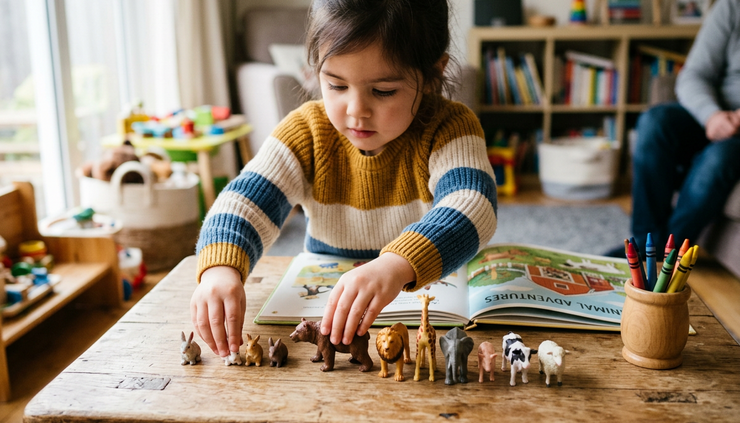
A five-minute activity after a show can stretch the learning. If an episode is about plants, water a houseplant. If it is about kindness, make a card. If it is about shapes, build with blocks. If it is about music, tap rhythms on pots or clap patterns.
Look beyond the episode itself
A show can be educational and still be a poor fit if the viewing setup does not work. How much children watch, when they watch, and what happens around screen time all matter.
Pediatric and child development groups generally encourage families to use screen time thoughtfully, keep limits consistent, and watch with young children when possible. The details will vary by child and household, but the principle is the same: screens should fit into family life, not crowd out sleep, outdoor play, conversation, and free play.
Before making a show part of the routine, ask a few practical questions.
Is the show easy to stop?
Some programs end each episode cleanly. Others roll straight into the next one, making stopping harder. Preschoolers often struggle with transitions, so choose shows with clear endings or use a timer, a visual cue, or a predictable phrase like, “When the song is over, the TV goes off.”
Does the show match your child’s sensitivity level?
Some children love big sounds and silly surprises. Others get overwhelmed. Watch for covering ears, hiding, repeated questions about scary scenes, trouble sleeping, or acting out scenes in a distressed way.
Are ads or previews part of the experience?
Many families choose ad-free options for preschoolers when possible because young children have a hard time telling the difference between a story and a sales message. If ads, trailers, or autoplay previews appear, they may shape what your child asks for next.
Can the show support your family’s routines?
A short, calm episode before dinner may work well. A loud, high-energy show right before bed may not. Some shows are better for active movement breaks. Others are better for quiet time with a caregiver nearby.
Does the lesson align with your values?
A show may teach letters well but handle behavior, family roles, conflict, or humor in ways that do not feel right. Trust that reaction. Families do not need to justify every “no.”
Use a simple checklist before pressing play
Choosing a show gets easier when the same standards guide each decision. Before adding a new program to the regular rotation, watch part of an episode yourself. Better yet, watch one full episode with your child before deciding.
Here is a practical checklist:
Clear purpose
The episode teaches or practices a skill preschoolers can understand.
Age-appropriate pace
Scenes are easy to follow, with pauses and repetition.
Positive modeling
Characters use words, kindness, problem-solving, and repair after mistakes.
Active participation
The show asks questions, encourages movement, or invites predictions.
Manageable emotions
Conflict feels safe enough for a young child.
Good transition
The episode has a clear ending and does not make stopping unusually hard.
Real-world connection
The topic can lead to a conversation, game, craft, song, or outdoor activity.
Family fit
The humor, values, noise level, and rhythm fit your home.
No show needs to score perfectly every time. A silly favorite can still have a place. The point is to build a media mix that mostly supports curiosity, language, empathy, and play.

A better way to think about screen time
Educational TV works best when it acts like a starting point, not the whole lesson. A strong show can introduce a new word, spark a question, or model a social skill. Real learning grows when children talk about it, act it out, test it, repeat it, and connect it to daily life.
The best choice is rarely the flashiest show. It is the one your child can follow, respond to, and carry into play. Look for clear lessons, calm pacing, respectful characters, active questions, and stories that leave room for imagination.
When the episode ends, ask one small question or try one simple activity. That is often where the real value shows up.


Comments